
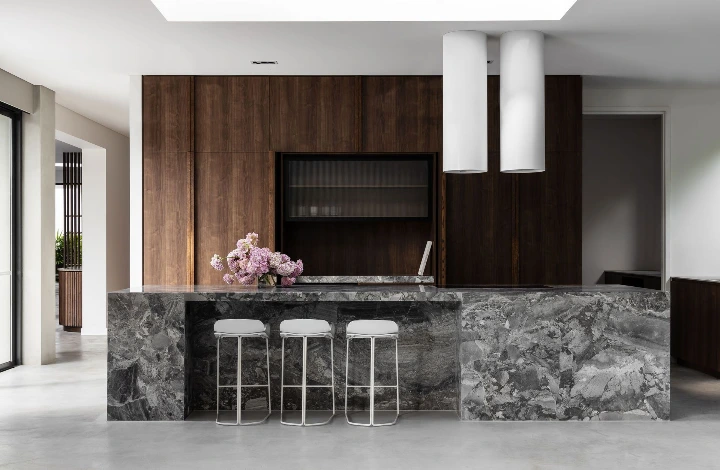
Luxury design evolves constantly. Materials come and go. Technologies promise breakthroughs every year. Yet one material continues to hold its position at the very top of residential and architectural specification lists:
Natural stone.
In 2026, the question is no longer “Is stone beautiful?”
It’s “Does stone still outperform modern alternatives when measured properly?”
When longevity, lifecycle value, repairability, environmental reality, and design integrity are examined together, the answer remains clear.
The Modern Surface Landscape: More Choice, More Confusion
Today’s luxury market offers an unprecedented range of surfaces:
Natural stone (marble, granite, quartzite, limestone, travertine)
Porcelain and sintered stone
Engineered stone and composite surfaces
Ultra-thin laminates and hybrids
Each category serves a purpose. But performance is often judged too narrowly — focusing on initial appearance or short-term durability rather than decades of use.
True luxury materials are not defined by novelty.
They are defined by how they perform over time.
Natural Stone vs Manufactured Surfaces: What Actually Matters
Authenticity & Material Depth
Natural stone is formed through geological processes that take millions of years. This results in depth, movement, and variation that cannot be replicated industrially.
Manufactured surfaces — no matter how advanced — are designed to imitate this appearance, not embody it. Consistency is their strength, but it is also their limitation.
In high-end spaces, uniqueness matters.
Stone delivers it inherently.
Durability Beyond the Marketing Claims
Porcelain and sintered surfaces perform exceptionally well in controlled tests. They are hard, non-porous, and stable.
However, durability in a laboratory is not the same as durability in a lived-in home.
Natural stone performs differently — not by resisting every mark, but by absorbing time gracefully. Minor wear becomes patina. Subtle changes enhance character rather than diminish value.
This distinction becomes critical over 10, 20, or 30 years of real use.
Lifecycle Cost: The 20–50 Year Perspective
Luxury materials should not be evaluated on upfront cost alone.
When assessed over decades:
Natural stone often remains in place for the life of the building
Many manufactured surfaces are replaced once design trends shift or damage becomes visually obvious
Stone can be refinished, repaired, or re-sealed rather than removed
When lifecycle cost is measured per year of use, natural stone frequently proves to be more economical long-term, despite higher initial investment.
Luxury is not cheap — but waste is expensive.
Repairability: An Overlooked Advantage
One of stone’s greatest strengths is rarely discussed.
Natural stone is repairable.
Chips can be restored. Surfaces can be honed or polished. Sealing can be renewed. Entire benchtops can be refreshed years later without replacement.
Many engineered and composite surfaces do not offer this flexibility. Once damaged, replacement is often the only solution.
Repairability is a cornerstone of sustainable luxury — and stone excels here.
Ageing & Patina: Why Wear Can Add Value
Luxury materials should age with dignity.
Stone does not aim to remain frozen in time. Instead, it evolves. Subtle patina tells a story of use, care, and continuity — qualities that resonate deeply in high-end residential design.
In contrast, uniform surfaces often reveal wear abruptly and unevenly, creating visual disruption rather than character.
Patina is not a flaw.
It is proof of longevity.
Resale Value & Buyer Perception
Across premium property markets, natural stone continues to act as a signal of quality.
Buyers associate stone with:
Craftsmanship
Structural permanence
Architectural intent
Long-term investment
In design-literate cities like Melbourne, stone is not viewed as a trend choice. It is seen as a baseline expectation in well-executed luxury homes.
While stone is rarely installed purely for resale, it consistently contributes to stronger buyer confidence and perceived value.
Environmental Reality: Beyond Simplified Sustainability Claims
Sustainability conversations around surfaces are often oversimplified.
Natural stone is:
Inert and non-toxic
Exceptionally long-lasting
Rarely replaced once installed
Free from synthetic binders and resins
Its environmental strength lies in longevity. Fewer replacements mean less waste, fewer transport cycles, and lower material turnover over the life of a building.
Manufactured surfaces may perform well technically, but many involve energy-intensive processes and shorter lifecycle expectations.
Sustainability is not just about production — it’s about how long something stays in use.
Where Stone Is Not the Best Choice (And Why That Matters)
True expertise includes restraint.
Natural stone is not ideal for every application:
Some marbles require regular sealing and mindful use
Certain outdoor or high-UV environments may favour porcelain
Heavy-impact commercial zones may require alternative materials
Acknowledging these limits strengthens trust and ensures better outcomes. Stone performs best when specified intelligently, not universally.
Why Stone Still Leads in 2026
Natural stone continues to outperform because it aligns with what modern luxury truly values:
Longevity over novelty
Repairability over disposability
Character over uniformity
Substance over surface-level performance
Stone is not competing with trends.
It exists beyond them.
Final Thought
In 2026, luxury is no longer defined by having more.
It is defined by choosing better.
Natural stone remains one of the few materials that satisfies aesthetic, functional, environmental, and emotional criteria simultaneously — and does so over decades, not design cycles.
That is why it continues to outperform.
Quietly. Consistently. Proven.