Some stones are beautiful on their own.
Bookmatched stone takes that beauty and mirrors it, turning natural veining into a piece of artwork that spans an entire wall, splashback or fireplace.
In this guide, we’ll explain what bookmatching is, how we plan it at Pazzi Marble & Granite, and where it works best in your home.
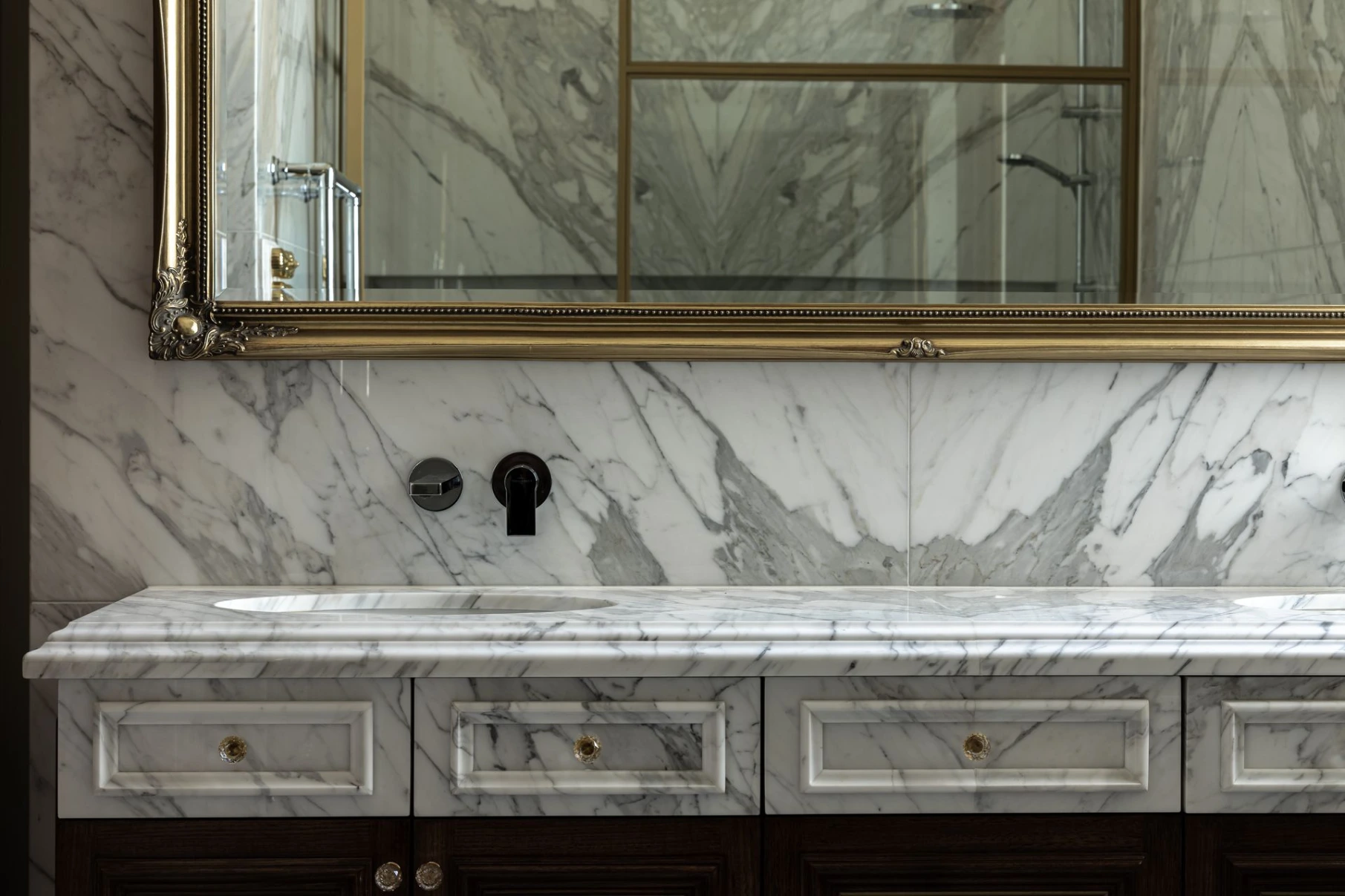
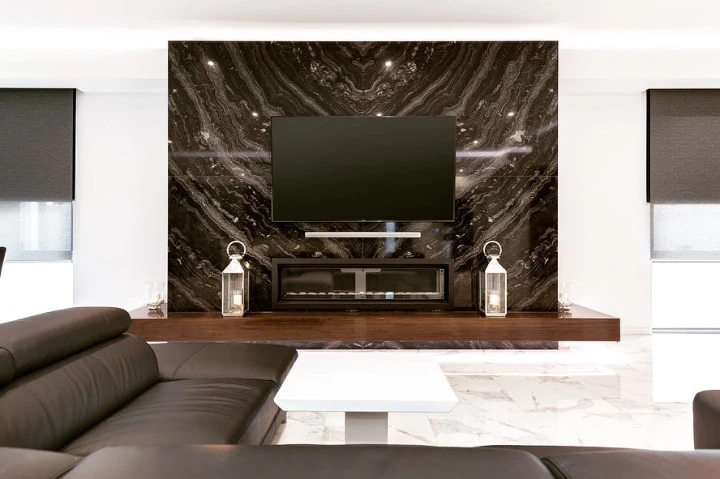
What is bookmatched stone?
Bookmatching is a technique where two or more slabs from the same block are placed side by side so their veining and patterns mirror each other, like the pages of an open book.
To create that effect, large stone blocks are sawn into consecutive slabs. Instead of polishing every slab on the same face, the processing alternates – one slab is polished on one side, the next on the opposite side – so when you place them in sequence, the pattern flips and mirrors.
Stones with bold movement and veining are ideal for bookmatching – many marbles, quartzites, and some granites and travertines naturally lend themselves to this kind of pattern play.
In some projects you’ll also hear terms like “quad-match”, where four slabs are combined to create an even larger symmetrical pattern.
How we plan a bookmatched design
A successful bookmatch isn’t accidental – it comes from careful planning before a single cut is made.
1. Choosing the right slabs
We start by selecting sequential slabs with the right kind of movement. In the slab yard, they’re usually bundled in the order they were cut from the block, so we can see how the veins travel from one to the next.
At this stage we’re asking:
- Where does the strongest vein run?
- Does it create a natural “centre line”?
- Is the pattern too busy or just right when mirrored?
2. Layout and vein mapping
Next comes layout planning – on paper and often digitally:
- We overlay your room dimensions onto slab photos or scans.
- We test different bookmatch centres: the middle of the cooktop, the centre of a fireplace, the centre of an island front.
- We decide where joins will land so they feel intentional, not random.
Slab diagrams and elevation drawings are prepared so everyone – client, designer, fabricator and installer – is working from the same plan.
3. Cutting, edging and dry-fitting
In the factory, the slabs are:
- Cut to size using bridge saws or CNC equipment for accuracy.
- Edges are profiled and finished (for example, mitred for islands and returns, or square with a small arris for wall panels).
- The full composition is dry-laid on the floor or racks to check that the mirror effect lines up exactly and that the transitions between slabs feel seamless.
Any micro-adjustments to joint position or trimming are sorted before the stone leaves the factory.
How we install bookmatched stone on site
Bookmatching is very sensitive to small errors – a few millimetres of movement can throw off the whole pattern – so installation is all about control and precision.
Key steps on site usually include:
- Substrate preparation
Walls or framing are checked for plumb, straightness and structural suitability. An uneven or weak substrate will show up immediately in the joins. - Setting out and levels
Laser levels and reference lines are used across the entire surface so each piece lands exactly where the layout drawing specifies. - Adhesive and fixing
Adhesive beds are combed to an even thickness, and panels are tapped in to remove voids and ensure full support. In many feature wall and fireplace scenarios, mechanical fixings or anchor systems are used behind the stone for additional security, especially with larger-format panels. - Fine adjustment
Each slab is nudged into place so the mirrored veins meet precisely at the centre line and follow through across joints. This is where the bookmatch truly “appears”.
The goal is simple: when you stand back, you should see one continuous artwork, not individual panels.
Where bookmatched stone works best
Bookmatching is all about making a statement. Here are the spaces where it tends to shine:
1. Kitchen splashbacks and range walls
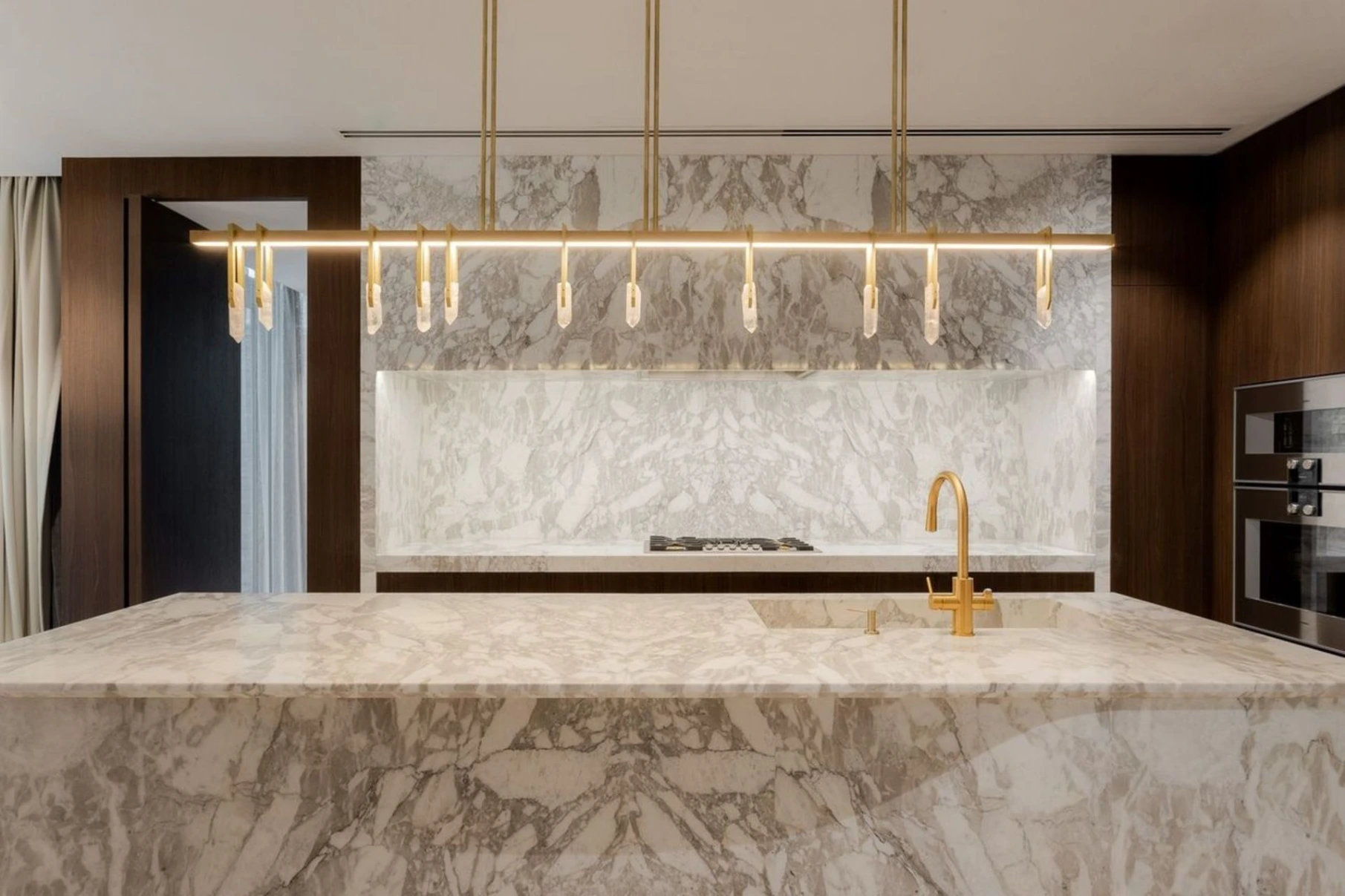
A bookmatched slab behind a cooktop or across the full back wall turns the splashback into a focal point. In many homes, the splashback is the easiest place to see and appreciate the pattern every day, and it pairs beautifully with more understated benchtops.
Great for:
- Full-height splashbacks
- Range walls framed by joinery
- Islands with bookmatched fronts and simple tops
2. Feature walls in living spaces
Bookmatched stone creates powerful feature walls in living rooms, entries and stair voids. The vertical scale really lets the pattern breathe, and lighting can be used to highlight movement and depth.
Great for:
- Entry statement walls
- Double-height voids
- Media walls and niches
3. Fireplaces and surrounds
Fireplaces are natural candidates for bookmatching: the opening becomes a natural centre line, and the stone frames it in a symmetrical way. Because fireplaces tend to be central in a room, the mirrored pattern becomes a strong visual anchor.
Great for:
- Full-height fireplace surrounds
- Mantel to ceiling bookmatched panels
- Hearths that continue the pattern across the floor
4. Islands, bar fronts and bathrooms
While bookmatching is often seen on walls, it can also be used on:
- Island fronts and bar faces – especially when paired with mitred ends so the pattern wraps.
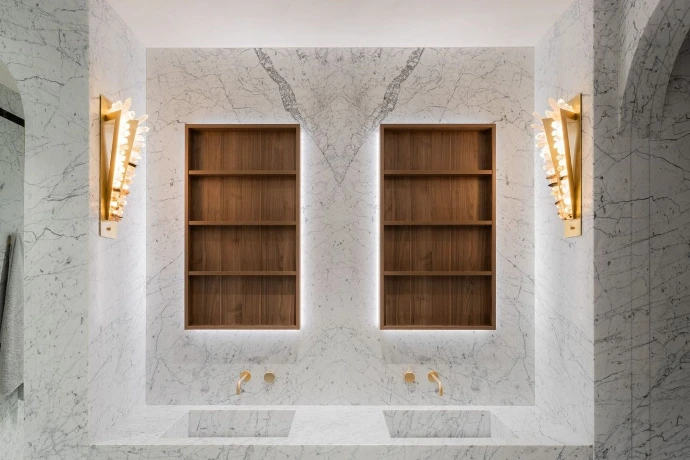
- Bathroom feature walls and shower back walls, turning the shower into a framed artwork.
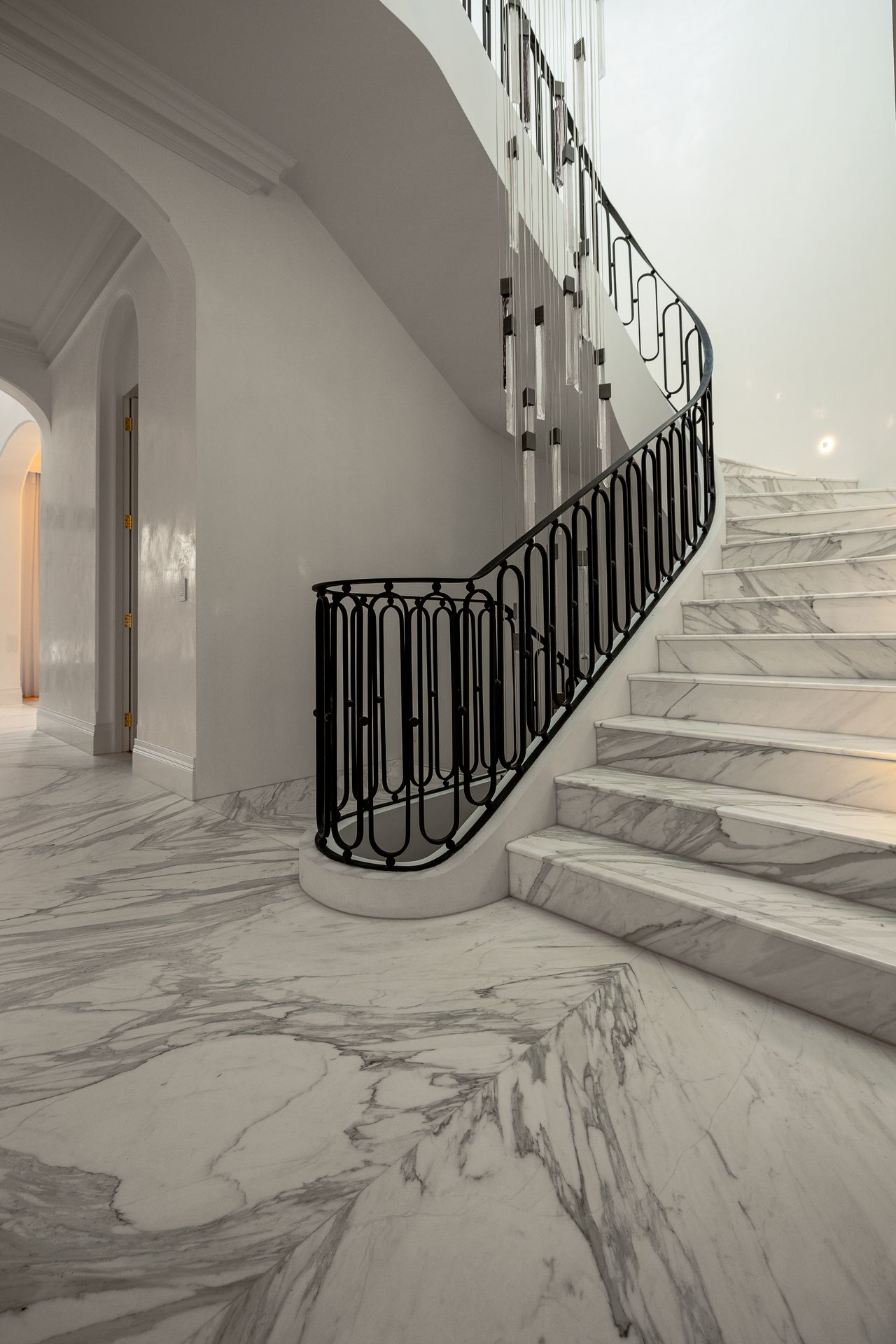
Before/after, layouts and finished shots
For a typical Pazzi bookmatched project, you’ll usually see three stages:
- Layout drawing
Elevations showing how the slabs will be cut and how the veins will run across the surface. - Slab layout / factory dry-fit
Photos of the slabs laid out in the yard or factory, so you can approve the composition before cutting or shipping. - Finished installation
Final photos or walkthroughs where you can compare the original layout drawing to the real-life result.
When these three match, you know the bookmatch has gone to plan.
Is bookmatched stone right for you?
A few quick questions to help you decide:
- Do you want one strong focal point in the room (rather than lots of competing finishes)?
- Are you drawn to bold veining and movement in stone?
- Are you comfortable investing a little more time in planning to get the statement just right?
If the answer is yes, bookmatched stone is worth exploring – especially for your splashback, feature wall or fireplace.
At Pazzi Marble & Granite, we’ll walk you through:
- Which stones in our range are suitable for bookmatching
- What’s possible with slab sizes and your room dimensions
- Layout options, joints, and how the pattern will land in your space
Bring your plans or photos, and we’ll help you turn your favourite slab into a piece of permanent artwork – set in stone.